In his essay "Standing Tall: Three statues, three lessons" Randell Jones writes
about another type of heroic statue; one that commemorates the human spirit, and the things that constitute a life well-lived. The writing honors two individuals (an enslaved Black man named "York", Dr. Simon Green Atkins, a Black intellectual) and a regiment of Black African men born in bondage in Hayti, and conscripted as mercenaries/military recruits to fight in America's Revolutionary War.
"Philosophers offer that a sense of a life well-lived comes from having something to love, something to do and something to hope for. Those elements are represented in the stories of three notable people, each represented by a statue, all in the South."
—Randell Jones
The philosopher who posited that a life well-lived is one with love, hope, and opportunity is Aristotle. In his Nicomachean Ethics, Aristotle discusses the concept of eudaimonia, which is often translated as “happiness” or “flourishing.” According to Aristotle, eudaimonia is the ultimate goal of human life and is achieved through living virtuously. He believed that a life well-lived is one in which individuals cultivate virtues such as love, hope, and opportunity, leading to a state of flourishing and fulfillment.
ASIDE: To his credit, on his deathbed, Aristotle confessed to his student that he had plagiarized some of his works from ancient Egyptian sources. This confession shed light on the irony of this essay, which attributes to "philosophers" , a sentiment which was likely passed on by Black Africans of Ancient Egypt, but adopted as Greek philosophy without attribution. In other words, the Greeks plagiarize liberally from Ancient Egyptians. Cultural appropriation is not exactly "the intellectual exchange between the two civilizations" that is represented by mainstream intelligentsia.
The essay is fine, until the extremely bigoted over simplification of the Haitian Revolution (1791–1804):
Randell's slapdash portrayal is the typical intellectual dishonesty we have come to expect from White historians (even in the effort to credit lost or little known Black historical figures!). To summarize the French military and it's Spanish, Polish and other European mercenary's defeat simply as: "Having lost 37,000 soldiers to yellow fever in Saint-Domingue [Hayti] and needing money for his war with Great Britain, in 1803, he offered to sell France’s Louisiana territory to the fledgling United States" is disrespectful, to say the least.
The Haitian Revolution was won for the freedom of enslaved people through the long-term planning[5], strategies and skill of its great soldiers/fighters (Makandal, Boukman, Toussaint, Dessalines, "Capois-La-Mort", Henri Christophe, Rigeau, Petion, Boyer... ) and brave women (Dahomey warriors, Victoria "Tante Toya" Montou), Cecile Fatima, Marie-Jeanne Lamartiniére, Suzanne Béliar, Marie Sainte Dédée Bazile, Catherine Flon...). It is an unconscionable injustice and beyond the pale (pun intended) to suggest otherwise.
[5](Cecile Fatima traveled to Plantations recruiting for the rebellion for two years before the 1791 Bwa Kayimen ceremony that launched the Haitian Revolution)
In this historical letter between Toussaint L'Ouverture and Jean-Jacques Dessalines; Toussaint directs the strategical way to defeat the French army, and this is precisely how they were dispatched. The great François "Capois-La-Mort" Capois courage at the Battle of Vertières being a brilliant example of the bravery and courage of the Armée Indigène (Indigenous Army).
It is a deeply concerning matter to just lightly skip over the part where Blacks fought thirteen (13) years of battles and skirmishes, and suffered more casualties than the United States in WWI[1].
The obvious needs saying here; these casualties are estimates, and the Haitian casualties are most assuredly downplayed.
The Haitian Revolution casualties and losses:
Haitians: 350,000+ dead
France: 75,000+ dead
British: 45,000+ dead
Spain: [100,000+] /"heavy losses"[2]
[1] During World War I, the U.S. suffered a total of 116,516 military casualties.
[2] The exact number of deaths from Spain during the Haitian Revolution is not definitively documented. However, it is estimated that thousands of Spanish soldiers and civilians lost their lives during the conflict.
Speaking of "heavy losses"...
Randell Jones: "10% of the island’s 550,000 population were the white elites and the mixed-race merchants and tradesmen. Ninety percent of the population were enslaved people brutally forced to work to maximize their productivity before they died of yellow fever in a year or two and were easily replaced in a steady African slave trade."
At 90%, the total number of enslaved on Ayiti were 495,000. Over 350,000 died for freedom, that's a genocide of over 60% of the enslaved Black people.
General Jean-Jacques Dessalines of the self-titled Armée Indigène ("Indigenous Army") declared:
"Yes, we have rendered to these true cannibals war for war, crime for crime, outrage for outrage; yes, I have saved my country; I have avenged America." He named the new Black Republic "Hayti" after the indigenous name given by the Taino, including the Higüey, Mariéns, Caracole (Black Moors[4]), Xaragua, Maguá, and Maguána.
[4] Spain was one of the major powers involved in enslaving African people, the vast majority of enslaved Africans were sent to Spanish colonies in the Americas. Some enslaved Africans were Moorish. No good deed (civilization, liberal arts schools, cities and street planning, WINE...) goes unpunished.
Henri Christophe unfortunately plotted with the mixed race sons of France the assassination of Dessalines (he was sort of a despot), and deeply regretted this; so depression (and his rebellious subjects, joined in rebellion by members of his army) may have lead to his suicide.
Also, why shouldn't a King of Hayti live a comfortable life (especially a triumphant battle worn general and hero)? Why are you counting his money; to distract from his accomplishments? In his time, Henri Christophe built the The Palace of Sans-Souci and Fort Citadelle Laferiere[3], structures which still stand today as monuments to honor his triumphant achievements and Hayti's halcyon days of glory.
[3] (a mountaintop fortress, located on the northern coast of Haiti - considered one of the eight wonders of the world and designated by the UNESCO as a World Heritage Site in 1982)
Haiti declared its independence on January 1, 1804, becoming the first nation to permanently abolish slavery, 30 years before Great Britain, over 40 years before France, and more than 60 years before the US.
In the essay, we learn about the virtues of the enslaved "York", and by contrast, the petty jealousies of his enslaver William Clark: " upon the expedition’s return, Clark continued to enslave him as property. Through all the adventures and encounters with new people, York had changed immensely, but Clark not at all."
STATUES
______________
Something to love: Freedom
The Haitian Monument commemorates the contributions of the Chasseurs-Volontaires de Saint-Domingue, a French regiment of free men of African descent, during the American Revolution.
The young drummer boy, who stands just to the left of the armed group, is Henri Christophe, an important leader in the Haitian Revolution and the only monarch of the Kingdom of Haiti.
Something to hope for: A better self
York, York's statue is at Lewis & Clark College in Louisville, KY overlooking the Ohio River. The statue honors York, the enslaved Black man who accompanied the Lewis & Clark expedition.
Something to do: Opportunity
Simon Green Atkins Statue, Simon Green Atkins: a statue of Dr. Atkins
E, e, Mbomba, e, e! Kanga Bafyòti. Kanga Mundele. Kanga Ndòki. Kanga yo!
Boukman's Righteous Prayer
"The God who created the earth; who created the sun that gives us light. The God who holds up the ocean; who makes the thunder roar.
Our God who has ears to hear. You who are hidden in the clouds; who watch us from where you are. You see all that the white has made us suffer.
The white men's god asks him to commit crimes. But the God within us wants to do good. Our God, who is so good, so just, He orders us to avenge our wrongs. It's He who will direct our arms and bring us the victory. It's He who will assist us.
We all should throw away the image of the white men's god who is so pitiless. Listen to the voice for liberty that sings in all our hearts."
Boukman's Prayer at the Bwa Kayiman Vodun ceremony, the call to action that launched the Haitian Revolution, on August 14, 1791.
The basis for forcing an experimental gene therapy on everyone was that it would end the COVID pandemic by preventing infection and spread. Real-world reality has since proven this to be a false justification
Authoritarian rulers claim to act from deep concern for public health and the greater good of society. Historically, however, invoking "the greater good" principle has always been about disenfranchising citizens in order to consolidate and concentrate power
Throughout the pandemic, governments, employers, NGOs and media have argued that the social responsibility to "protect others" is so paramount that it negates all other considerations
But unless everyone has bodily autonomy, no one has bodily autonomy, and without it, everyone, including the most vulnerable, are put at risk. Hence, the rationale to "protect the vulnerable" falls apart unless everyone is allowed to make their own decisions
When everyone has to sacrifice themselves for others, then everyone's autonomy is violated — including that of the most vulnerable. The COVID vaccination campaign is a glaring example of this. Many who got the shots are still getting sick, many have been injured or died from the side effects, while those who refused to comply lost their jobs and, in some areas, can't even enter a store. Everyone has lost protection rather than gained it
Government officials, public health officials, media and a whole host of other talking heads that parrot official talking points have repeatedly lied to us. We knew this, but now — without apology — they're all starting to "admit" it by subtly changing the narrative.
As noted by comedian Jimmy Dore in the August 3, 2022, episode of "The Jimmy Dore Show" (video above):
"This story is very close to my heart, because it exonerates me. They've been lying about COVID, they've been lying about the vaccines, they've been lying about herd immunity, they've been lying about natural immunity, they've been lying about masks.
They've been lying about children — they've been lying about everything! Who'd have thunk the government and Big Pharma would lie to us? For profit? I am flummoxed. I am beside myself with slack-jawedness."
Now, They're Eating Their Own Words
He goes on to review specific examples, such as President Biden claiming "You're not going to get COVID if you have these vaccinations." Or Dr. Anthony Fauci, who said "When they are vaccinated, they can feel safe they are not going to get infected."
Or Canadian Prime Minister Justin Trudeau, who stated, "If you've done the right thing and gotten vaccinated, you deserve the freedom to be safe from COVID-19." (Word salad aside — can you "deserve freedom to be safe" from an infection? — nevertheless, he makes the point that you supposedly won't get COVID if you got the jab.)
Vice President Kamala Harris said, "If you are vaccinated, you are protected." Daniel Andrews, premier in Victoria, Canada, claimed that with three doses, you would be "prevented not only from serious illness, but from getting this virus, this Omicron variant, and therefore giving it to others."
Victoria chief health officer professor Brett Sutton, who got the AstraZeneca jab, insisted it was a "very effective vaccine" that reduced "risk of transmission."Every one of these officials has now contracted COVID, some two or three times.
Knew the Shots Were Leaky
A primary objection to vaccine mandates was, as Dore points out, that a leaky "vaccine" — one that doesn't actually prevent infection and spread — cannot protect anyone other than the one getting the shot. So, the argument that COVID jab refusers were killing people was false. The notion that getting the jab would protect people around you was rubbish.
"These were lies," Dore says, "they were not making a mistake. They were lying."
What's the incentive for lying about an injection that clearly cannot do what you say it can? Dore suggests they were lying on behalf of their donors — Pfizer, Moderna, et. al. Of course, the National Institutes of Health,1,2 for example, also owns patents related to these jabs, so they make money from them directly.
So, with the truth now being self-evident, why aren't media asking why Fauci, Biden, Harris, Trudeau and the rest were spreading misinformation? Where's the follow-up? And where are the apologies? Rachel Maddow, would you like to revise this proven-untrue statement, made on "The Rachel Maddow Show?"
"Instead of the virus being able to hop from person to person to person, spreading and spreading … now we KNOW that the vaccines work well enough; that the virus STOPS with every vaccinated person.
A vaccinated person gets exposed to the virus, the virus does not infect them, the virus can then not use that person to go anywhere else. It cannot use a vaccination person as a host to get more people. That means the vaccines will get us to the end of this."
This propaganda did not age well, and that's putting it mildly. Now, they're trying to sidestep the landmines of truth — real-world realities — and claim that the shots were never intended to prevent infection, it was always about preventing serious illness and keeping you out of the hospital. But the statements quoted above, which is just a small sampling, prove otherwise.
The very basis and justification for forcing an experimental gene therapy on everyone was that it would end the pandemic by preventing infection and spread. People lost their jobs over that fraudulent justification. Friendships have been lost and family ties broken because people believed the propaganda that said if you don't get the shot, you don't care about others. Your very presence could be lethal to them. So, if you care about others, you will get the shot.
Do Authoritarians Care About You?
That brings us to a more important question, and that is, do these authoritarians actually care about any of us? They claim the reason for their actions is their deep concern for public health and the good of society. But is that really the case? Or is it just a PR strategy?
After all, coming out and saying you want to reduce the population by some percentage, or eliminate the financial drain by the elderly and the handicapped, isn't going to encourage compliance with the strategies intended to bring about those effects, is it. It would make more sense to tell people to comply "for their own good, and the good of others." Then, the intended effect — depopulation — is brought about by voluntary sacrifice.
Totalitarianism as 'Care'
In "Totalitarianism as 'Care,'"3 political commentator Elena Louisa Lange dissects the biomedical regime's moral imperative to "protect the vulnerable," which in 2020, for the first time, came to mean that everyone, regardless of personal risk, had to isolate, wear a mask and get an experimental gene therapy, "regardless of the price in bodily integrity and autonomy."
The left's pretense of 'protecting the vulnerable' is not only politically and socially corrosive. It also rests, philosophically, on an indefensible and authoritarian rationale. ~ Elena Louisa Lange
In a show of solidarity never before seen, hundreds of companies changed their logos and brand slogans to promote the COVID jabs. Political parties, schools, media, nongovernmental organizations (NGOs) also told us to just get the jab — or else. The following extract from Lange's article is a bit longer than usual, but the expanded context is what makes Lange's point clear. Beyond this, I recommend reading her article in its entirety:4
"The rhetoric of 'vulnerability' and 'care' bullied the masses into accepting a string of human- and civil-rights violations, such as being imprisoned in our own homes, the oxymoronic 'social distancing,' masking, and, above all, mandated vaccinations unprecedented in their severity and global scale.
Yet the left's pretense of 'protecting the vulnerable' is not only politically and socially corrosive. It also rests, philosophically, on an indefensible and authoritarian rationale.
The exclusive attention given to the abstract framework of 'vulnerability' and 'solidarity,' 'community' and 'care' — always 'for others,' never for oneself — served to disguise the loss of income and psychological damage caused by large-scale civil-rights suspensions …
The idea of vulnerability as a guiding political principle of the left goes back to the birth of social-democratic and labor parties in the early 20th century. It was the working class that needed protection from the cruel vicissitudes of the market …
But since the emergence of the neoliberal consensus in the 1970s, a remarkable shift has taken place … It is no longer the working class … but specific identity groups, the racially marginalized and the sexually excluded, who became 'vulnerable subjects' …
What really cemented the PMC [professional-managerial class] left's rise to power, however, was a more fundamental epistemic shift. The left … usually busy declaring everything to be a 'social construct,' suddenly proclaimed the novel coronavirus to be a 'natural phenomenon,' a 'challenge by uncontrollable natural forces' … the virus was to be seen as a self-acting agent with its own subjective intent, motives, even political agenda.
This fetishistic inversion — ascribing autonomous powers to a lifeless thing — legitimated technocratic solutions like lockdowns and the feverishly promoted mass vaccinations, no matter the social costs. Moreover, turning the virus into an intentional agent shifted the blame for suicides and domestic violence, the loss of income, and extreme police violence against protesters, away from the politicians and bureaucrats, and onto 'nature.'
A pathogen … is only as severe as the social response to it. If the response, justified as an 'objective constraint' of the virus, is more lethal than the cause, then we are dealing with a disastrous fallacy …
'[V]ulnerability' in the PMC's imagination had to be shifted from vulnerable groups in the precise sense (the elderly, children, precarious service workers, etc.) to an undifferentiated whole under constant attack from the enemies of civil society, which happened to be the professionals' own political enemies.
This move conveniently enabled the identification of the 'fight against the virus' with the 'fight against fascism,' conflating questions of medical hygiene with those of 'social hygiene.'
The vocal denunciation of critics of the biopolitical security state as 'right-wingers,' conspiracy theorists, anti-vaxxers, and so on was only legible, and consequential, against the backdrop of this conflation, for it put the question of the defeat of the virus on par with the victory of the left."
Transhistorical Rationale of Civil-Rights Violations
How are "vulnerable" people "protected" by the destruction of lives and livelihoods, and the removal of basic civil rights and Constitutional freedoms? Our authoritarian leaders have yet to explain this self-defeating rationale. All we get is Orwellian double-speak, where war is peace and slavery is freedom.
Lange points out that once you go beyond political motives, the argument against forced vaccinations tells us a lot about the transhistorical rationale of civil-rights violations by the state.
Throughout history, the driving objective of power-hungry elites is the disenfranchisement of ordinary citizens. And how do you disenfranchise people? By taking away basic rights, such as the right to drink a cup of coffee or eat a meal you're willing and able to pay for in a restaurant, lest you first submit to medical experimentation.
And how do you get people to submit to medical experimentation? By shaming them as egotists who care nothing for society. In a fiery speech, 23-year-old Green Member of the German Bundestag, Emilia Fester (quoted in full by Lange), argued that:
"It is not mandated vaccination that is the imposition, but no mandated vaccination — an imposition for the solidarity-based majority … Getting vaccinated can no longer be an individual decision!"5
Violation of Physical Boundaries Protects No One
Throughout the pandemic, governments, employers, NGOs and media have argued that the social responsibility to "protect others" is so paramount that it negates all other considerations. According to them, one individual's freedom and bodily autonomy ends where the freedom and autonomy of another begins.
Rather than being sovereign individuals who make decisions for ourselves, we are to view ourselves as links in a never-ending chain, where every decision you make will impact the people around you, and if your decision has even so much as the potential to restrict their freedom and autonomy — such as, for example, if you make them sick so they can't work or socialize — then you "don't have the right" to make that decision.
As noted by Lange, the moral imposition can be summarized as: "Give up your bodily integrity to protect the bodily integrity of others." But rather than protecting others, the end result is the opposite, because it creates "infinite regress."
In other words, if I give up my bodily integrity for you, then you have to give up yours for others, who also have to give up theirs, and so on. So, in the end, no one has the right to, ever, say no to anything, even if what's asked might cause injury or death.
Since there's no backstop, and everyone has to sacrifice themselves for others, no one is actually protected. Instead, everyone's at risk. Everyone's autonomy has been violated — including that of the most vulnerable. The COVID vaccination campaign is a glaring example of this.
Many who got the shots are still getting sick, many have been injured or died from the side effects, while those who refused to comply lost their jobs and, in some areas, can't even enter a store. Everyone has lost rather than gained, and in more ways than one.
Bodily Integrity for All Is the Best Protection
Not only does the demand of self-sacrifice for others put the most vulnerable at risk of injury and death, since they too must roll the dice with risky medical interventions in order to "protect others," but it also eliminates our moral ability to defend and protect the physical autonomy of others. If we cannot defend our own boundaries, how can we defend the boundaries of others?
Sadly, we now have real-world examples of where this all leads. Children and adults in need of organ transplants, for example, are being denied life-saving procedures for lack of COVID injection, even though the shot is more likely to kill them than protect anyone around them (supposedly the already COVID-jabbed and boosted hospital staff). We've entered a state of such massive moral degradation that it hardly seems human anymore.
The only way to actually protect people and minimize harm is by allowing everyone to do what they think is best for themselves. As noted by Lange:6
"In consequence, either there is general physical autonomy for each and every single individual, implying mutual respect for one's physical boundaries, or there is none. The violation of physical boundaries … is never in the interest of the 'vulnerable,' because the protection of bodily integrity itself is already the best guarantee for the protection of 'others,' as well as oneself: It is, in fact, the only guarantee of physical protection for everyone.
This becomes even more apparent in the COVID case when we consider that the vaccinated can be infected and can infect others, and, therefore, potentially hurt them. In this sense, the logical framework for COVID mass vaccinations in the name of 'vulnerability' is self-defeating."
'Social Care' Narrative Is About Consolidation of Power
One of the key take-home messages in Lange's article is that this "social care" and "responsibility for others" paradigm is a ploy used to consolidate power.
In her words:7
"In sum, the claim to 'protect the vulnerable' is the more or less direct demand to yield to political disenfranchisement under the guise of the honorable project of care … The left's political project of 'protecting the vulnerable' is nothing short of window-dressing authoritarianism."
The authoritarians don't actually care about people and their health. Anyone can realize this simply by analyzing their actions, rather than their words. They care about controlling people as a means to gain more power. Of course, the more power they get, the more they need to control you, lest you rise up and strip them of that power.
The hallmark call of authoritarian and totalitarian regimes is to "serve the greater good" by sacrificing selfhood. Everything is about the collective. There's no room for individuality. In my interview with psychologist Mattias Desmet, he explains the psychology of totalitarianism, and the conditions that precede the rise of totalitarian systems.
The same "care" narrative is also being used to prop up the "climate emergency." We're now told we have to sacrifice our standard of living because we have a responsibility for others and for the earth. We have to rein in our personal carbon footprint because pollution is deadly, and if you don't, you're — again — responsible for widespread death.
While pollution is a reality that needs to be addressed, the solutions the totalitarian cabal is offering is a gigantic scam designed to disempower and control everyone but the ones at the very top of the power pyramid, while accomplishing little in terms of producing a cleaner environment.
Dominicans publicly beating a Haitian man they had tied to a street pole.
Have you peeped the new game the genocidal colonist are playing? They've teamed up with their little poodle puppets in the DR.
They're now claiming that Ayiti and Haytians are part of "Latin America." Best laugh yet: we are "Latin-ex. "
By that logic Californians are Mexican and New Englanders in places named after indian tribes (Ex. Abnaki · Hammonassett · Mahican · Mattabesset · Mi'kmaq · Mohegan · Montauk · Natick) are now to be known as "Native Americans." 🙃
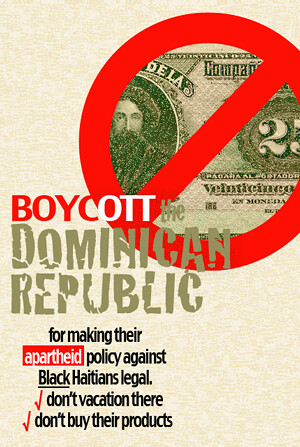
In the Dominican Republic dispossessed Haitians are under armed guard on plantations harvesting sugarcane, most of which ends up in US kitchens. Cutting cane by machete, they work 14 hour days, 7 days a week, frequently without access to decent housing, electricity, clean water, education, healthcare or adequate nutrition.
Link to full length movie here: The Price Of Sugar
HLLN in partnership to help transfer solar engineering skills to Haitian women. Solar power will make Haiti's rural women and urban poor less dependent on USAID/ UN /NGOs.
Support Zili Dlo's solar programs for clean water and generating power from the sun. Clean Water is life and HealthSupport Zili Dlo – Clean Water for Everyone in Haiti
Join our fundraising committee, or book an Ezili Danto presentation. Help Ezili's HLLN raise funds to finance education for Haiti's solar engineers and water trucks for more clean water delivery for our communities. Write to erzilidanto@yahoo.com.
****************************************************
Haitian Lawyers Leadership Network
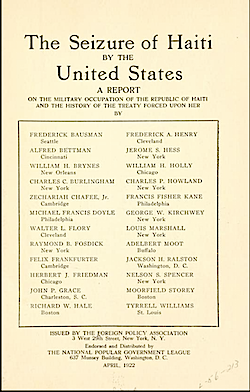
The Seizure of Haiti by the US: A Report on the Military Occupation of Haiti and the
History of the Treaty Forced Upon Her
Issued by The Foreign Policy Association
Endorsed & distributed by The National Popular Government League - April 1922
"Hearings before a Select Committee of the U.S. Senate pursuant to Senate Resolution 112, authorizing an inquiry into the occupation and administration of the territories of the Republic of Haiti."
You may use, publish, distribute, link to my articles provided that you respect copyrights. My name and that of this blog must be mentioned at all times.
Haitian Peasants Against Monsanto
A large demonstration of at least 10,000 farmers had occurred in central Haiti on Friday, June 4. organized by "Mouvman Peyizan Papay" or MPP, the peasants and a contingent of youths from the capital marched for three hours to the town of Hinche to protest the American multinational company Monsanto and demand the burning of 475 tons of roundup ready genetically modified seeds the company was trying to "give" Haiti.